Short answer: local SEO for dentists means getting your practice into Google’s map results and top local listings when nearby patients search for things like “dentist near me”, “emergency dentist” or “Invisalign [city]”. It rests on four things: a complete and specific Google Business Profile, one page on your website for each treatment you want to be found for, a steady flow of genuine patient reviews, and consistent practice details across the web.
Most dental searches are local and urgent. Someone with a cracked tooth on a Saturday isn’t reading blog posts. They’re tapping one of the first three practices in the map. Here’s how to become one of them.
How Google Decides Which Practices Show in the Map
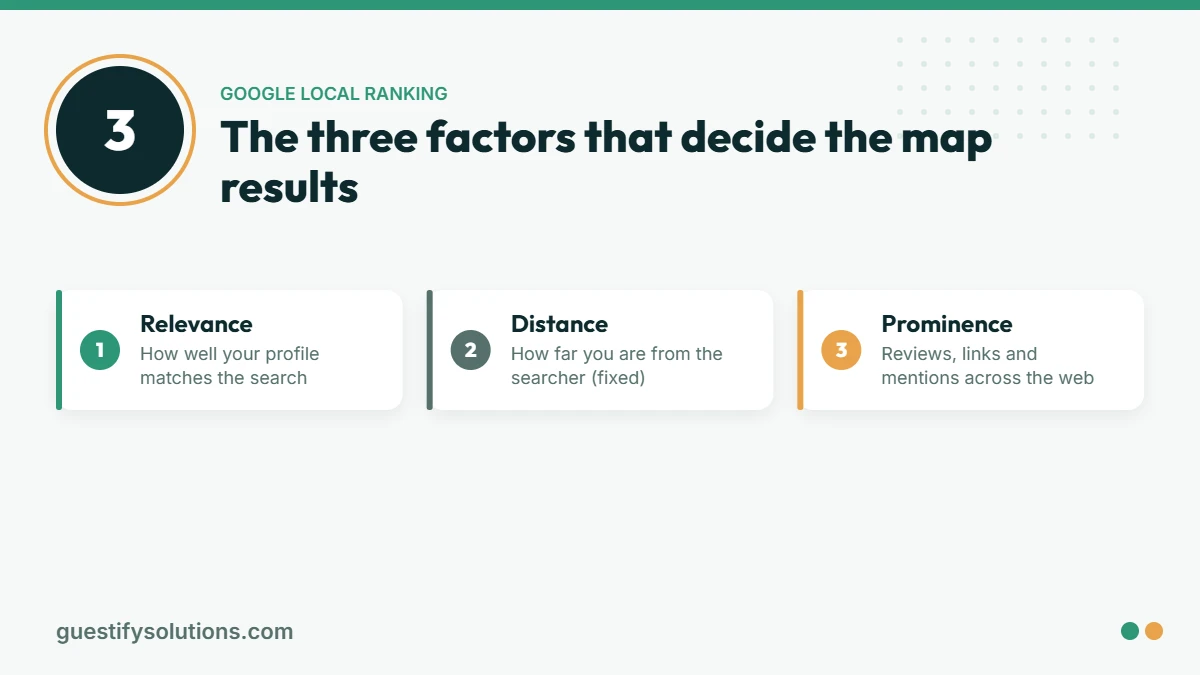
Google says local results are mainly based on three factors: relevance, distance and prominence.
- Relevance is how well your Business Profile matches the search. If you offer emergency appointments but your profile never mentions them, you’re less relevant to “emergency dentist”.
- Distance is how far you are from the searcher. You can’t change it, which is why a practice ten minutes away may outrank you for someone on the far side of town.
- Prominence is how well-known your practice is. Google says it draws on information from across the web, including links, articles and directories, and that more reviews and better ratings can help your ranking.
Everything below improves relevance or prominence, the two factors you can actually influence.
Step 1: Get Your Google Business Profile Right
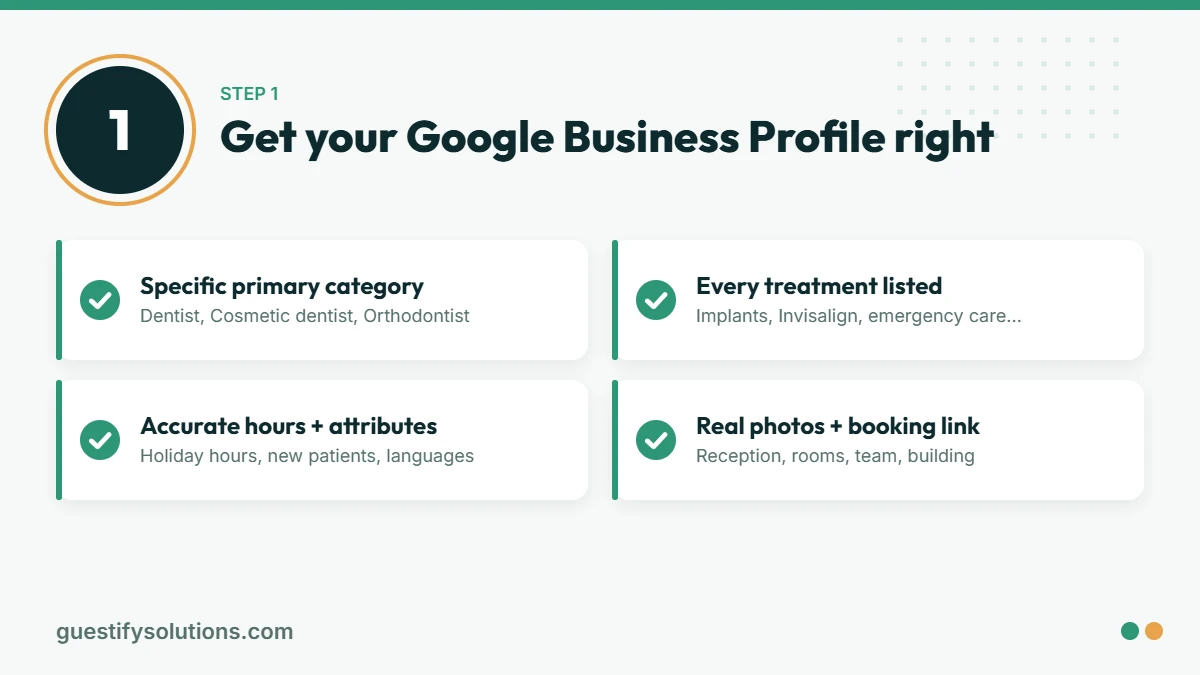
This is the highest-leverage hour you’ll spend on dental marketing.
- Primary category: choose the most specific one that fits (“Dentist”, “Cosmetic dentist”, “Pediatric dentist”, “Orthodontist”). Add secondary categories only for services you genuinely offer.
- Services: list each treatment separately, such as check-ups, hygiene, fillings, root canals, crowns, implants, whitening, Invisalign or clear aligners, and emergency appointments. Each one is a relevance signal.
- Hours: keep them accurate, including holiday hours. If you take emergency patients outside normal hours, say so clearly.
- Attributes: wheelchair access, languages spoken, new patients accepted, online booking. Patients filter on these.
- Photos: real photos of your reception, treatment rooms, team and the outside of the building, so patients recognise it when they arrive. Skip the stock images.
- Booking link: point it straight to your online booking page, not your homepage.
Our full Google Business Profile optimisation guide goes field by field.
Step 2: Build One Page Per Treatment
The most common problem we see on dental websites is a single “Services” page that lists fifteen treatments in a paragraph each. That page can’t rank for “dental implants [city]” because it isn’t really about implants.
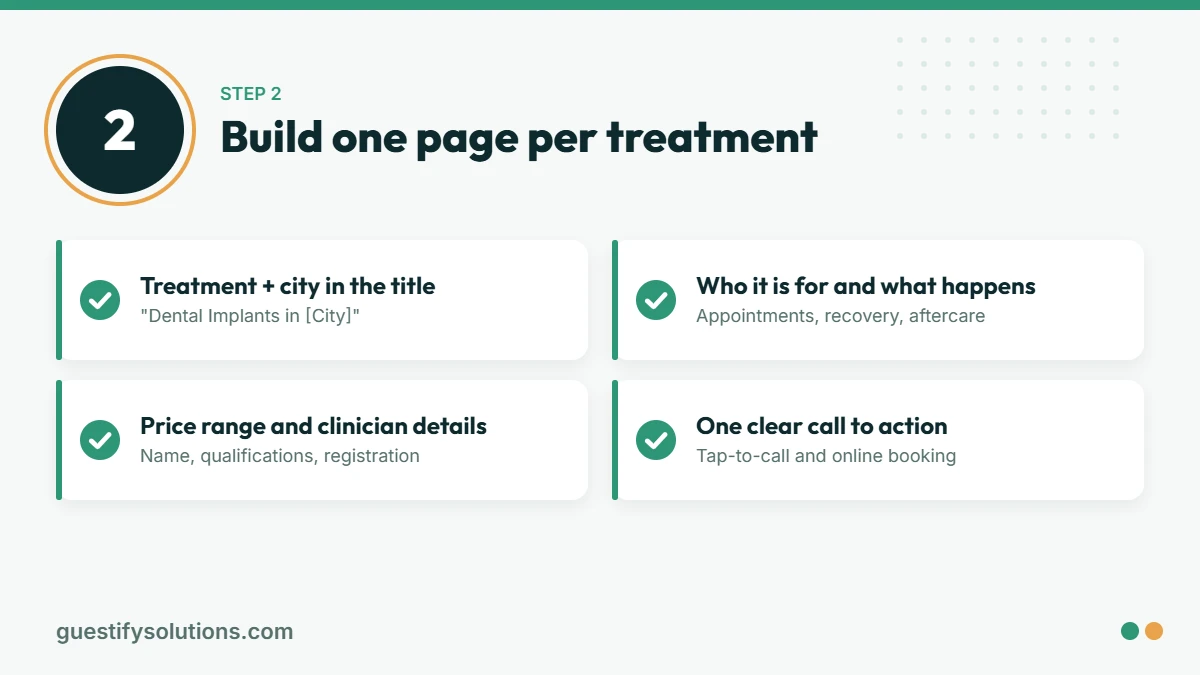
Create a dedicated page for each treatment that brings in significant revenue or volume. For most general practices that’s implants, Invisalign or clear aligners, emergency dentistry, cosmetic dentistry or veneers, teeth whitening and children’s dentistry. Each page should:
- Lead with the treatment and location in the title, for example “Dental Implants in [City] | [Practice Name]”
- Explain who it’s for, what happens at each appointment, recovery and aftercare
- Give a price range or “from” price if you can. Patients search for cost constantly, and pages that answer it hold their attention.
- Show the treating clinician’s name, qualifications and registration
- Answer the 4–6 questions patients actually ask at consultations
- Have one clear call to action, such as “Book a consultation” with a phone number that can be tapped on mobile
Dental content is health content, so Google holds it to a high standard of accuracy and expertise. Have a qualified clinician review every page, name them as the reviewer, and avoid promising outcomes.
Step 3: Make Reviews Part of the Appointment Routine
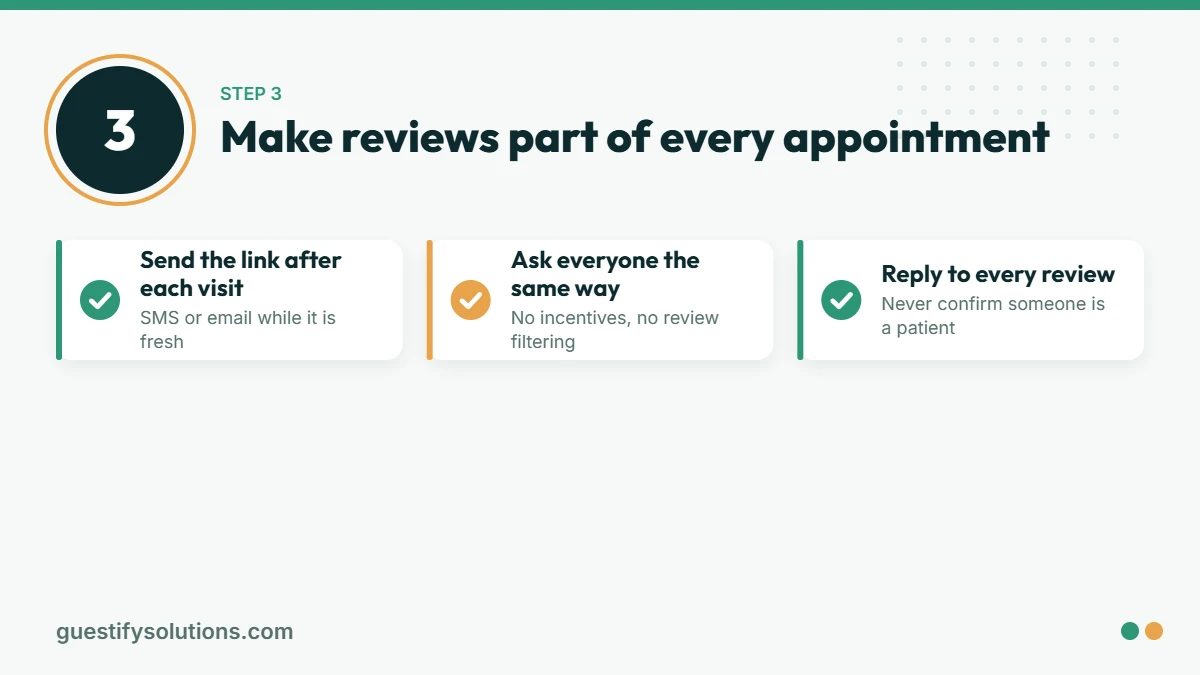
Reviews feed prominence, and they are what patients read before choosing between three practices in the map. The practices that build steady reviews don’t rely on remembering to ask. They build it into the workflow:
- Send a review link by SMS or email shortly after the appointment, while the experience is fresh
- Ask every patient the same way. Never offer discounts or gifts for reviews, and never filter so only happy patients get the link. Google’s policies prohibit both.
- Reply to every review. Thank people for the positive ones. For negative ones, respond calmly, never confirm that the reviewer is a patient or mention treatment details (patient confidentiality applies), and invite them to contact the practice directly.
Step 4: Make Your Practice Details Consistent Everywhere
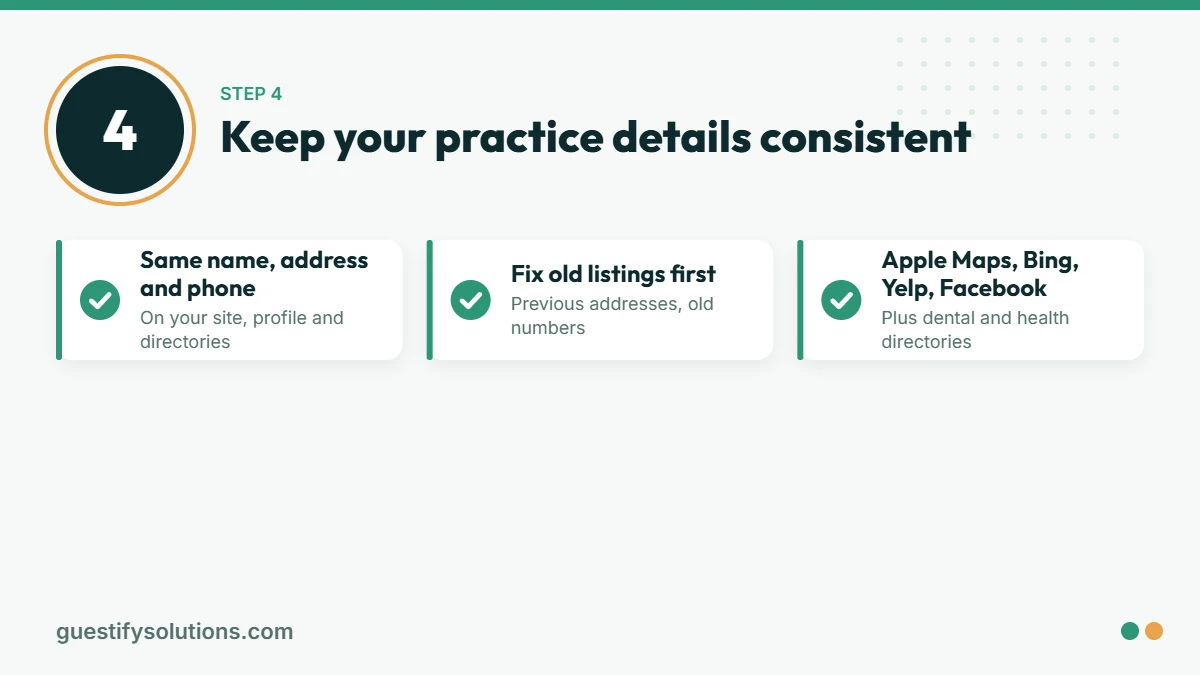
Your practice name, address and phone number (NAP) should be identical on your website, your Google Business Profile and the directories that matter. Old addresses from a previous location, or a tracking number on one listing and your main number on another, create confusion. Start with the big general directories (Apple Maps, Bing Places, Yelp and Facebook) and the dental and healthcare directories in your country. Fix existing listings before creating new ones.
Step 5: Earn Local Mentions
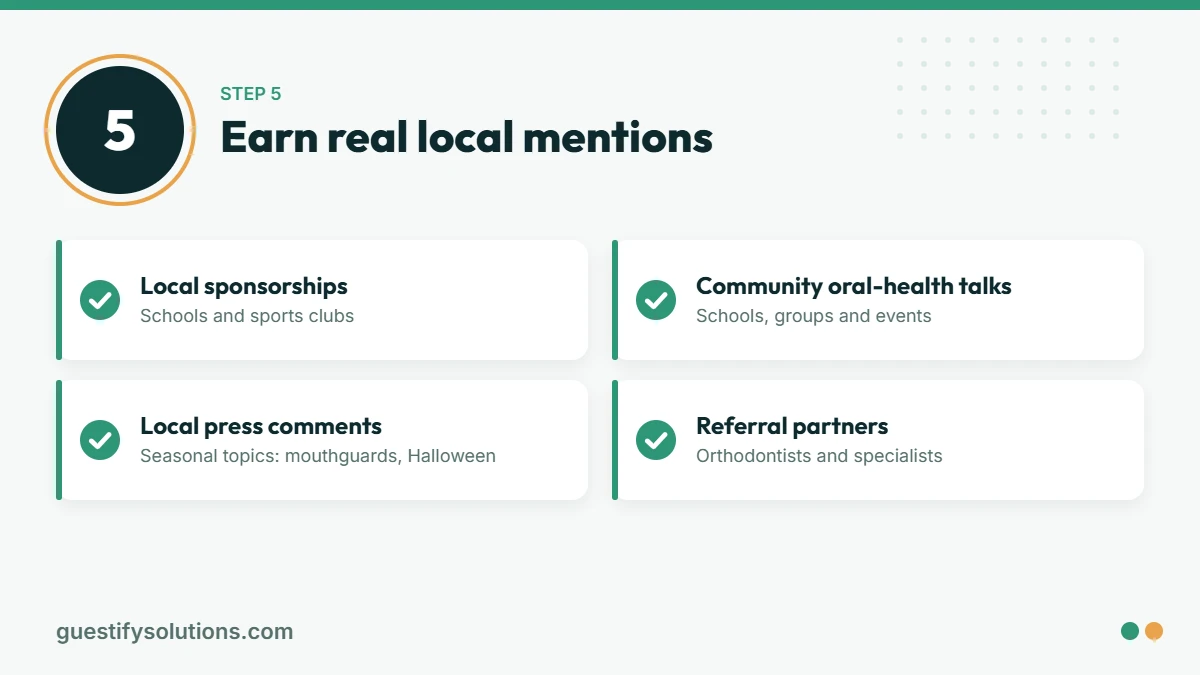
Links and mentions from real local sources build prominence in a way directories can’t. Practical options for a dental practice include sponsoring a local school or sports club, giving oral-health talks at schools or community groups, being quoted in local press about seasonal topics (sports mouthguards, Halloween sugar), and partnering with local orthodontists or specialists who refer to you. None of these are quick, but each one is a real reason for a local site to link to you.
Step 6: Track Calls and Bookings, Not Just Rankings
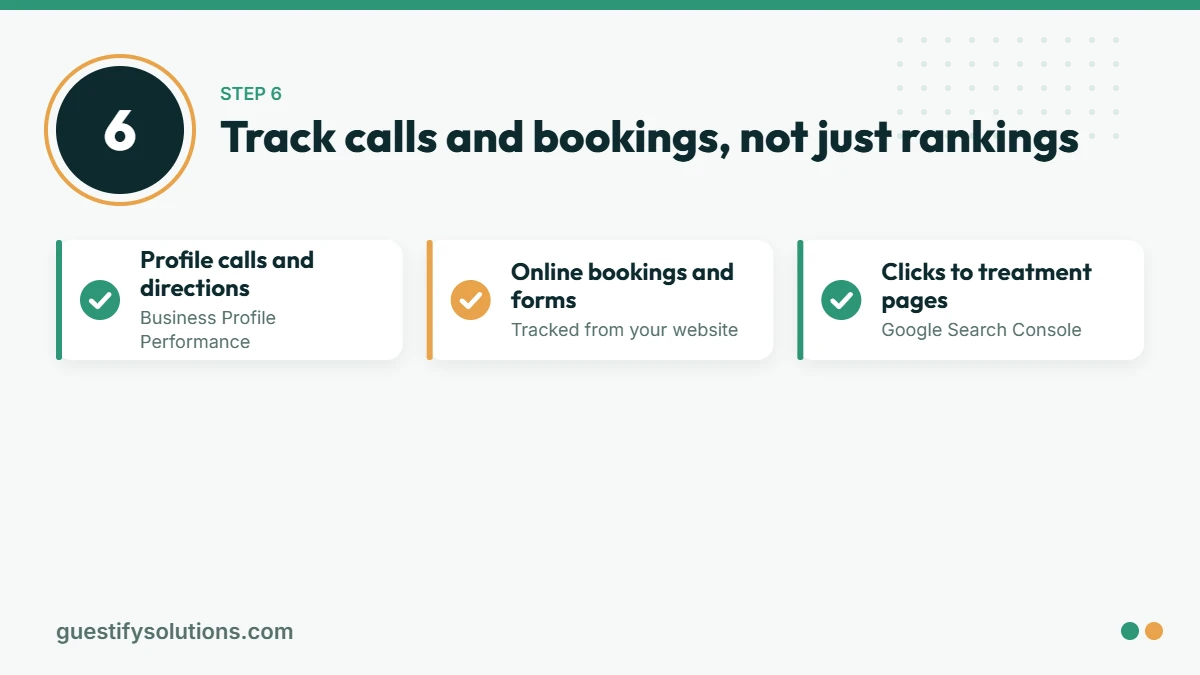
A map-pack ranking is only useful if it produces patients. Track three things monthly: calls and direction requests from your Business Profile (in the profile’s Performance section), booking-form submissions from your website, and organic clicks to treatment pages in Google Search Console. If you use a call-tracking number on your website, keep your main number as the primary number on Google to protect NAP consistency.
What Results Look Like (Sample Numbers)
Illustration only, not a client result. Suppose a single-location practice gets 400 profile views and 25 calls a month from Google. Completing the profile, adding treatment pages and building a review routine typically lifts relevance first. You’d expect to see the profile appear for more treatment searches within the first few months. Prominence (reviews, mentions) builds more slowly. The honest range for a meaningful, stable improvement in a competitive city is usually several months to a year, depending on how strong the nearby practices already are.
How Much Does Local SEO for a Dental Practice Cost?
It depends on competition and how much work the site needs. A practice in a small town with little competition may need a one-time setup plus light monthly upkeep. A multi-location group in a major city needs ongoing content, review management and link building. Our SEO cost guide breaks down typical market rates. Be wary of anyone who guarantees “#1 in the map”. Nobody controls Google’s results, and distance alone means rankings differ from street to street.
FAQ
Why doesn’t my practice show up for “dentist near me”?
“Near me” results depend heavily on the searcher’s location, so you may show for people close to you but not across town. If you don’t show even nearby, check that your Business Profile is verified, your primary category is “Dentist” (or a more specific dental category), and your profile is complete.
Should I create a Business Profile for each dentist in the practice?
Google allows individual practitioner profiles in some cases, but they can compete with your main practice listing. For most single-location practices, one strong practice profile is the better choice. Multi-location groups need one profile per location.
Is Google Ads better than SEO for dentists?
Ads put you at the top immediately, which is useful for high-value treatments like implants or for a new practice. SEO builds visibility that doesn’t stop when the budget does. Many practices run both, starting with ads while SEO builds. We compare them in SEO vs Google Ads.
Can I write my own treatment pages?
Yes, and you’ll often write the most accurate ones. Have a clinician review them, keep claims factual, and follow your professional regulator’s advertising rules.
Get a Free Local SEO Audit for Your Practice
We’ll review your Google Business Profile, treatment pages, reviews and citations against the practices currently ranking above you, then tell you what’s holding you back and what to fix first. Request your free audit →
Related: Local SEO services · SEO for healthcare practices · The local SEO checklist